PhD Students
Dr. Swati Saha(PhD: 2021–2025)
After PhD:
“Probing QCD matter via fluctuations, correlations, and flow in heavy-ion collisions at the LHC”
PhD Publications (included in thesis):
- Long-range transverse momentum correlations and radial flow in Pb−Pb collisions at the LHC, ALICE Collaboration arXiv:2504.04796 - accepted in Physica; Review Letters.
- pT-differential radial flow in blast-wave model, Swati Saha, Ranbir Singh, Bedangadas Mohanty Phys. Rev. C 112, 024902 – Published 7 August, 2025.
- Measurement of correlations among net-charge, net-proton, and net-kaon multiplicity distributions in Pb−Pb collisions at sNN‾‾‾‾√=5.02 TeV, ALICE Collaboration JHEP 08 (2025) 210. li> Skewness and kurtosis of mean transverse momentum fluctuations at the LHC energies, ALICE Collaboration Phys. Lett. B 850 (2024) 138541.
Dr. Prottay Das(PhD: 2017–2024)
After PhD: CERN Fellow, Switzerland
“Studying chiral magnetic wave, hadronic rescattering and 𝑓 (1285) production in high energy collisions with ALICE detector”
PhD Publications (included in thesis):
- System size dependence of the hadronic rescattering effect at energies available at the CERN Large Hadron Collider, ALICE Collaboration Phys. Rev. C 109, 014911 (2024).
- Probing the Chiral Magnetic Wave with charge-dependent flow measurements in Pb-Pb collisions at the LHC, ALICE Collaboration JHEP 12 (2023) 067.
- K∗(892)± resonance production in Pb−Pb collisions at sNN = 5.02 TeV, ALICE Collaboration Physical Review C 109 (2024) 044902. li> Global constraint on the magnitude of anomalous chiral effects in heavy-ion collisions, Wen-Ya Wu, Qi-Ye Shou, Panos Christakoglou, Prottay Das, Md. Rihan Haque, Guo-Liang Ma, Yu-Gang Ma, Bedangadas Mohanty, Chun-Zheng Wang, Song Zhang, Jie Zhao Phys. Rev. C 107, L031902 – Published 21 March, 2023. li> Measurement of f1(1285) production in pp collisions at s√ = 13 TeV, ALICE Collaboration Phys. Lett. B 866 (2025) 139562.

Dr. Mouli Chaudhuri(PhD: 2018–2024)
After PhD: Postdoctoral position at Fudan University,Shanghai, China
“Characterisation of cryogenic detectors and study of backgrounds in rare event search experiment”.
PhD Publications (included in thesis):
- A novel active veto prototype detector with an inner target for improved rare event searches, M. Chaudhuri, A. Jastram, G. Agnolet, S. Banik, H. Chen, et al. Nuclear Instruments and Methods in Physics Research Section A: Accelerators, Spectrometers, Detectors and Associated Equipment 1039 (2022), p. 167150.
- Development of a large-mass, low-threshold detector system with simultaneous measurements of athermal phonons and scintillation light, M. Chaudhuri, G. Agnolet, V. Iyer, V.K.S. Kashyap, M. Lee, et al. Nuclear Instruments and Methods in Physics Research Section A: Accelerators, Spectrometers, Detectors and Associated Equipment 1053 (2023), p. 168374.
- Low-threshold sapphire detector for rare event searches, S. Verma, S. Maludze, M. Lee, M. Chaudhuri, V. Iyer, et al. Nuclear Instruments and Methods in Physics Research Section A: Accelerators, Spectrometers, Detectors and Associated Equipment 1046 (2023), p. 167634.

Dr. Ashish Pandav(PhD: 2019–2023)
After PhD: Postdoctoral fellow at Lawrence Berkeley national Laboratory, Califiornia, USA
“Probing the QCD Phase Diagram via Net-proton Number Fluctuation at RHIC”.
PhD Publications (included in thesis):
- Nonmonotonic Energy Dependence of Net-Proton Number Fluctuations [STAR Collaboration], Phys. Rev. Lett. 126 (2021) no.9, 092301.
- Measurement of the Sixth-Order Cumulant of Net-Proton Multiplicity Distributions in Au+Au Collisions at √sNN = 54.4, and 200 GeV at RHIC [STAR Collaboration], Phys. Rev. Lett. 127 (2021), 262301.
- Beam Energy Dependence of Fifth and Sixth-Order Net-proton Number Fluctuations in Au+Au Collisions at RHIC [STAR Collaboration], Phys. Rev. Lett. 130 (2023), 082301.
- Cumulants and correlation functions of net-proton, proton, and antiproton multiplic- ity distributions in Au+Au collisions at energies available at the BNL Relativistic Heavy Ion Collider [STAR Collaboration], Phys. Rev. C 104 (2021) no.2, 024902.
- Effect of limited statistics on higher order cumulants measurement in heavy-ion collision experiments. A. Pandav, D. Mallick and B. Mohanty, Nucl. Phys. A991 (2019) 121-608.
- Search for the QCD Critical Point in High Energy Nuclear Collisions (An experimental review article). A. Pandav, D. Mallick and B. Mohanty, Prog. Part. Nucl. Phys. 125 (2022), 103960.

Dr. Debasish Mallick(PhD: 2016–2022)
After PhD: Postdoctoral position at Warsaw University of Technology, Poland
“Probing thermalization and deuteron production mechanism via fluctuations in heavy-ion collisions in STAR at RHIC”.
PhD Publications (included in thesis):
- Collision energy dependence of deuteron cumulants and proton-deuteron correlations in Au+Au collisions at RHIC [STAR Collaboration], Phys. Lett. B 855, 138560 (2024).
- Limits of thermalization in relativistic heavy ion collisions,Sourendu Gupta, Debasish Mallick, Dipak Kumar Mishra, Bedan- gadas Mohanty, and Nu Xu, Phys. Lett. B 829, 137021 (2022).
- Effect of limited statistics on higher order cumulants measurement in heavy-ion collision experiments. A. Pandav, D. Mallick and B. Mohanty, Nucl. Phys. A991 (2019) 121-608.
- Search for the QCD Critical Point in High Energy Nuclear Collisions (An experimental review article). A. Pandav, D. Mallick and B. Mohanty, Prog. Part. Nucl. Phys. 125 (2022), 103960.
Dr. Dukhishyam Mallick(PhD: 2016–2023)
After PhD: Postdoctoral fellow at IJCLab, Orsay, France
“Studying multiplicity and rapidity dependence of K* production and probing initial conditions of high energy collisions with ALICE at LHC energies”.
PhD Publications (included in thesis):
- K∗(892)0 and φ(1020) production at midrapidity in pp collisions at √s= 8 TeV [ALICE Collaboration], Phys. Rev. C 102 (2020) 024912.
- K∗(892)0 and φ(1020) production at midrapidity in p–Pb collisions at sNN = 8.16 TeV, [ALICE Collaboration], Phys. Rev. C 107 (2023) 055201.
- Multiplicity and rapidity dependence of K∗(892)0 and φ(1020) production in p–Pb collisions at sNN = 5.02 TeV [ALICE Collaboration], Eur. Phys. J. C 83 (2023) 540
- Study of charged particle multiplicity, average transverse momentum and azimuthal anisotropy in Xe+Xe collisions at √sNN = 5.44 TeV using AMPT model, S. Kundu, D. Mallick, B. Mohanty, Eur. Phys. J. A 55, 157 (2019)

Dr. Susil Kumar Panda (PhD: 2018–2023)
After PhD: Continues with Job at BSNL
“Study of the Freeze out and thermodynamic scenario of the systems produced during high energy collisions.””.
PhD Publications (included in thesis):
- Effect of new resonance states on fluctuations and correlations of conserved charges in a hadron resonance gas model, Subhasis Samanta, Susil Kumar Panda and Bedangadas Mohanty International Journal of Modern Physics E Vol. 27, No. 10 (2018) 1850080.
- Freeze-out scenarios in small systems at RHIC and LHC energies, Susil Kumar Panda, Subhasis Samanta, Ajay Kumar Dash, Ranbir Singh, Rita Paikaray Int.J.Mod.Phys.E 29 (2020) 02, 2050006.
- Multiplicity dependence of freezeout scenarios in pp collisions at s=7 TeV, Susil Kumar Panda, Sandeep Chatterjee, Ajay Kumar Dash, Bedangadas Mohanty, Rita Paikaray Phys.Rev.C 104 (2021) 6, 064905.

Dr. Samir Banik (PhD: 2015–2021)
After PhD: Postdoctoral fellow at Technical University of Vienna (TU Wein).
“Search for Lightly Ionizing Particles in SuperCDMS and simulation of neutron backgrounds”.
PhD Publications (included in thesis):
- Constraints on Lightly Ionizing Particles from CDMSlite, (SuperCDMS collaboration), Phys. Rev. Lett. 127 (8 2021), p. 081802.
- Simulation of neutron background for a dark matter search experiment at JUSL,S. Banik, V.K.S. Kashyap, M.H. Kelsey, et al. JINST 16.06 (2021), P06022.
- Simulation of energy loss of fractionally charged particles using Geant4,S. Banik, V. K. S. Kashyap, S. Ghosh, et al. Nuclear Instruments and Methods in Physics Research Section A: Accelerators, Spectrometers, Detectors and Associated Equipment 971 (2020), p. 164114.

Dr. Vijay Iyer (PhD: 2015–2021)
After PhD: Postdoctoral fellow at University of Toronto and SNOLAB
Development and calibration of semiconductor detectors for dark matter searches.
PhD Publications (included in thesis):
- Large mass single electron resolution detector for dark matter and neutrino elastic inter- action searches, V. Iyer et. al. Nucl Instrum. and Methods A 1010 (2021), p. 165489
- Ionization yield measurement using photo-neutron sources in germanium CDMSlite de- tectors, (SuperCDMS collaboration), Phys. Rev. D 105, 122002 – Published 17 June, 2022
Dr. Ashutosh Dash (PhD: 2016–2021)
After PhD: Humboldt Fellow at Frankfurt Institute of Advanced Studies
Influence of hadronic interactions and magnetic field on the bulk properties of matter produced in heavy-ion collision.
PhD Publications (included in thesis):
- Interacting hadron resonance gas model in the 𝐾-matrix formalism, Ashutosh Dash, Subhasis Samanta, and Bedangadas Mohanty Phys. Rev. C 97, 055208 – Published 9 May, 2018
- Transport coefficients for multicomponent gas of hadrons using Chapman-Enskog method, Ashutosh Dash, Subhasis Samanta, and Bedangadas Mohanty Phys. Rev. D 100, 014025 – Published 23 July, 2019
- Thermodynamics of a gas of hadrons with attractive and repulsive interactions within an 𝑆 -matrix formalism, Ashutosh Dash, Subhasis Samanta, and Bedangadas Mohanty Phys. Rev. C 99, 044919 – Published 29 April, 2019,
- Magneto-vortical evolution of QGP in heavy ion collisions, Ashutosh Dash, Victor Roy and Bedangadas Mohanty, J. Phys. G, 46(1), 015103.

Dr. Sourav Kundu (PhD: 2014–2020)
After PhD: Fellow, CERN Geneva
Angular and momentum distribution of vector mesons produced in proton–proton and heavy-ion collisions at LHC energies
PhD Publications (included in thesis):
- Evidence of spin–orbital angular momentum interactions in relativistic heavy-ion collisions, ALICE Collaboration (S. Acharya et al.), Phys. Rev. Lett. 125, 012301 (2020) [Editor’s Suggestion]
- Multiplicity dependence of K*⁰(892) & φ(1020) production in pp collisions at 13 TeV, ALICE Collaboration (S. Acharya et al.), Phys. Lett. B 807, 135501 (2020)
- Production of light flavour hadrons in pp collisions at √s = 7 and 13 TeV, ALICE Collaboration (S. Acharya et al.), arXiv:2005.11120, accepted in Eur. Phys. J. C
- Study of charged particle multiplicity, average transverse momentum and azimuthal anisotropy in Xe+Xe collisions at √sNN = 5.44 TeV using AMPT model, S. Kundu, D. Mallick, B. Mohanty, Eur. Phys. J. A 55, 157 (2019)

Dr. Vipul Bairathi (PhD: 2013–2019)
After PhD: Postdoctoral Fellow, IISER Berhampur, followed by a position at the University of Tarapacá, Chile.
Azimuthal anisotropy of strange and multi-strange hadrons in heavy-ion collisions at RHIC
PhD Publications (included in thesis):
- Bulk properties of the system formed in Au+Au collisions at 14.5 GeV, Phys. Rev. C 101, 024905 (2020).
- Centrality dependence of identified particle elliptic flow in relativistic heavy-ion collisions at 7.7–62.4 GeV, Phys. Rev. C 93, 014907 (2016).
- Probing Pb+Pb collisions at √sNN = 2.76 TeV with spectators, Phys. Lett. B 754, 144–150 (2016).
- Selecting specific initial configurations using spectator neutrons in U+U collisions, Phys. Rev. C 91, 054903 (2015).
- A review on ϕ-meson production in heavy-ion collisions, Adv. High Energy Phys. 2015, 197930 (2015).

Dr. Debadeepti Mishra (PhD: 2013–2019)
Research Focus: Freeze-out dynamics and particle production studies in heavy-ion collisions using STAR detector data at RHIC.
Particle Production Studies in Au+Au and U+U Collisions using the STAR detector at RHIC and Understanding the Freeze-out Dynamics
PhD Publications (included in thesis):
- Bulk properties of the system formed in Au+Au collisions at 14.5 GeV, Phys. Rev. C 101, 024905 (2020).
- Freeze-out conditions in proton-proton collisions at top RHIC and LHC energies, Phys. Rev. C 95, 014912 (2017).
- Freeze-out systematics due to the hadron spectrum, Phys. Rev. C 96, 054907 (2017).
- Freeze-out parameters in heavy-ion collisions at AGS, SPS, RHIC & LHC energies, Adv. High Energy Phys. 2015, 349013 (2015).

Dr. Kishora Nayak (PhD: 2012–2018)
After PhD: Postdoctoral Fellow, Central China Normal University (CCNU), China
K* production at high transverse momentum in Pb–Pb collisions and high-multiplicity pp collisions at LHC energies
PhD Publications (included in thesis):
- K*⁰(892) and ϕ(1020) meson production at high transverse momentum in pp and Pb–Pb collisions at √sNN = 2.76 TeV, Phys. Rev. C 95, 064606 (2017).
- Multiplicity dependence of light-flavor hadron production in pp collisions at √s = 7 TeV, Phys. Rev. C 99, 024906 (2019).

Dr. Md. Rihan Haque (PhD: 2010–2015)
After PhD: Postdoctoral Fellow, Utrecht University, The Netherlands
Nuclei production and azimuthal anisotropy of charged particles in heavy-ion collisions at RHIC [PhD Thesis]
PhD Publications (included in thesis):
- Elliptic and triangular flow in asymmetric heavy-ion collisions, Phys. Rev. C 84, 067901 (2011).
- Multiplicity, average transverse momentum and azimuthal anisotropy in U+U collisions at √sNN = 200 GeV using AMPT model, Phys. Rev. C 85, 034905 (2012).
- Fluctuating initial condition and smoothing effect on elliptic and triangular flow, Phys. Rev. C 86, 037901 (2012).
- Event-by-event hydrodynamic simulations for √sNN = 200 GeV Au+Au collisions and correlation between flow coefficients and initial asymmetry measures, Phys. Rev. C 87, 034907 (2013).
- Elliptic flow of light nuclei and identified hadrons: energy and centrality dependence in STAR, Nucl. Phys. A 931, 915 (2014).
- Measurement of elliptic flow of light nuclei at √sNN = 200, 62.4, 39, 27, 19.6, 11.5 & 7.7 GeV at RHIC, Phys. Rev. C 94, 034908 (2016).

Dr. Sabita Das (PhD: 2010–2015)
After PhD: Postdoctoral Fellow, Central China Normal University (CCNU), China
Present: Assistant Professor of Physics,
K.K.S. Women’s College, Balasore, Odisha
Identified particle production and freeze-out dynamics in STAR at RHIC Beam Energy Scan Program [PhD Thesis]
PhD Publications (included in thesis):
- Bulk properties of the medium produced in relativistic heavy-ion collisions from the Beam Energy Scan program, Phys. Rev. C 96, 044904 (2017).
- Identified particle production and freeze-out properties in heavy-ion collisions in the RHIC BES program, EPJ Web Conf. 90, 08007 (2015).
- Freeze-out parameters in heavy-ion collisions at AGS, SPS, RHIC & LHC energies, Adv. High Energy Phys. 2015, 349013 (2015).
- Cosmic-ray test of mini-drift thick GEM for Transition Radiation Detector, Nucl. Instrum. Methods A 785, 33–39 (2015).
- Chemical freeze-out parameters in the Beam Energy Scan program at STAR, EPJ Web Conf. 90, 10003 (2015).
- Study of freeze-out dynamics in STAR at RHIC Beam Energy Scan program, J. Phys. Conf. Ser. 509, 012066 (2014).
- Centrality dependence of freeze-out parameters from the Beam Energy Scan at STAR, Nucl. Phys. A 904, 891c (2013).

Dr. Subhash Singha (PhD: 2009–2014)
After PhD: Postdoctoral Fellow, Kent State University, USA
(Stationed at Brookhaven National Laboratory)
Identified particle production in p+p and Pb+Pb collisions at LHC energies [PhD Thesis]
PhD Publications (included in thesis):
- Studying re-scattering effects in heavy-ion collisions through K* production, Int. J. Mod. Phys. E 24, 1550041 (2015).
- Inclusive photon production at forward rapidities in p+p collisions at √s = 0.9, 2.76 and 7 TeV, Eur. Phys. J. C 75, 146 (2015).
- K*(892)⁰ and ϕ(1020) production in Pb–Pb collisions at √sNN = 2.76 TeV, Phys. Rev. C 91, 024609 (2015).
- Production of K*(892)⁰ and ϕ(1020) in p+p collisions at √s = 7 TeV, Eur. Phys. J. C 72, 2183 (2012).
- Energy dependence of (p̅/p) ratio in p+p collisions, Phys. Rev. C 82, 044902 (2010).

Dr. Md. Nasim (PhD: 2009–2014)
After PhD: Postdoctoral Fellow, University of California Los Angeles (UCLA), USA
Current: Faculty, IISER Berhampur
(Profile link)
Azimuthal anisotropy measurements for identified particles produced in Au+Au collisions at √sNN = 7.7–200 GeV [PhD Thesis]
PhD Publications (included in thesis):
- Observation of an energy-dependent difference in elliptic flow between particles and antiparticles in relativistic heavy-ion collisions, Phys. Rev. Lett. 110, 142301 (2013).
- Elliptic flow of identified hadrons in Au+Au collisions at √sNN = 7.7–62.4 GeV, Phys. Rev. C 88, 014902 (2013).
- Elliptic flow of ϕ mesons: a sensitive probe for the onset of deconfinement in high-energy heavy-ion collisions, Phys. Rev. C 87, 014904 (2013).
- Inclusive charged hadron elliptic flow in Au+Au collisions at √sNN = 7.7–39 GeV, Phys. Rev. C 86, 054908 (2012).
- Longitudinal scaling of observables in heavy-ion collision models, Phys. Rev. C 83, 054902 (2011).
- Energy dependence of elliptic flow from heavy-ion collision models, Phys. Rev. C 82, 054908 (2010).

Dr. Ranbir Singh (PhD: 2008–2014)
After PhD: Research visit to University of Catania, Italy
Current: Scientist, NISER Bhubaneswar
(Profile link)
Azimuthal anisotropy measurements in Pb+Pb collisions at √sNN = 2.76 TeV and identification of jet-like events in PMD
PhD Publications (included in thesis):
- Selected experimental results from heavy-ion collisions at LHC, Adv. High Energy Phys. 2013, 761474 (2013).
- Energy dependence of inclusive photon elliptic flow in heavy-ion collision models, J. Phys. G 39, 055002 (2012).
- Charged particle anisotropic flow (v₂, v₃, v₄) in Pb–Pb collisions at midrapidity measured by ALICE, Proc. Sci. (CPOD 2013) 054.
- Identification of jet-like events at forward rapidities using PMD at LHC energies, Proc. DAE Symp. Nucl. Phys. 56, 958 (2011).
- Elliptic flow of inclusive photons at forward rapidities in heavy-ion collision models, Proc. DAE Symp. Nucl. Phys. 56, 1008 (2011).

Dr. Chitrasen Jena (PhD: 2006–2012)
After PhD: Postdoctoral Fellow, University of Padua, Italy
Current: Faculty, IISER Tirupati
(Profile link)
Particle production and elliptic flow of light nuclei in relativistic heavy-ion collisions at RHIC [PhD Thesis]
PhD Publications (included in thesis):
- Observation of the antimatter helium-4 nucleus, Nature 473, 353–356 (2011).
- Elliptic flow of light nuclei in Au+Au collisions at √sNN = 200 GeV, Nucl. Phys. A 862–863, 281–284 (2011).
- Longitudinal scaling of observables in heavy-ion collision models, Phys. Rev. C 83, 054902 (2011).
PhD Scholars Who Conducted Major Parts of Their Thesis Research Under My Guidance

Dr. Pawan Kumar Netrakanti (PhD: 2003–2006)
After PhD: Postdoctoral Fellow, Purdue University, USA
Current: Scientist, Nuclear Physics Division, BARC Mumbai
(Profile link)
Photon production in nucleus–nucleus collisions at forward rapidities at RHIC energies [PhD Thesis]
PhD Publications (research conducted in my group):
- Multiplicity and pseudorapidity distributions of photons in Au+Au collisions at √sNN = 62.4 GeV, Phys. Rev. Lett. 95, 062301 (2005). [arXiv:0502008]
- Quark participants and global observables, Phys. Rev. C 70, 027901 (2004). [arXiv:0401036]
- Multiplicity and pseudorapidity distributions of charged particles and photons at forward pseudorapidity in Au+Au collisions at √sNN = 62.4 GeV, Phys. Rev. C 73, 034906 (2006). [arXiv:0511026]
- The width of the rapidity distribution in heavy-ion collisions, Phys. Rev. C 71, 047901 (2005). [arXiv:0504004]

Dr. Sadhana Dash (PhD: 2004–2009)
After PhD: INFN Postdoctoral Fellow, University of Torino, Italy
Current: Faculty, Department of Physics, IIT Bombay
(Profile link)
Study of K*(892) resonance production in relativistic heavy-ion collisions at RHIC [PhD Thesis]
PhD Publications (research conducted in my group):
- K*⁰ production in Cu+Cu and Au+Au collisions at √sNN = 62.4 and 200 GeV, Phys. Rev. C 84, 034909 (2011). [arXiv:1006.1961]

Dr. Lokesh Kumar (PhD: 2004–2009)
After PhD: Postdoctoral Fellow, Kent State University (stationed at BNL)
Then: Scientific Officer E, NISER Bhubaneswar
Current: Faculty, Department of Physics, Panjab University, Chandigarh
(Profile link)
Identified particle production, fluctuations and correlations in heavy-ion collisions at RHIC [PhD Thesis]
PhD Publications (research conducted in my group):
- Identified particle production, azimuthal anisotropy, and interferometry in Au+Au collisions at √sNN = 9.2 GeV, Phys. Rev. C 81, 024911 (2010). [arXiv:0909.4131]
- System-size dependence of transverse momentum correlations at √sNN = 62.4 and 200 GeV at RHIC, Phys. Rev. C 87, 064902 (2013). [arXiv:1301.6633]
Masters Students Thesis

Ms. Roli Esha (M.Sc.: 2012–2013)
Pursued M.Sc. thesis research at NISER
After masters: Graduate Student, University of California, Los Angeles (UCLA)
Her research involved implementing both optical and Monte-Carlo Glauber models to estimate:
- Initial geometry: nucleon participants, binary collisions, eccentricity
- Initial magnetic field and angular momentum in heavy-ion collisions
- Charged-particle multiplicity systematics vs. centrality
- Connection of spatial eccentricity to elliptic flow (v₂)
- Extraction of η/s using Knudsen-number based scaling
The work also explored RHIC Beam Energy Scan physics — studying how v₂(pₜ) reflects changing QCD medium properties and possible signatures of phase transition dynamics at high baryon density.

Mr. Evan John Philip (M.Sc.: 2013–2014)
Pursued M.Sc. thesis research at NISER
After masters: Graduate Student, Stony Brook University, New York (USA)
Hydrodynamics and momentum distribution of hadrons in high-energy heavy-ion collisions
Research Summary:
This thesis examined transverse momentum spectra of produced hadrons across a wide range of collision energies (√sNN ≈ 9–2760 GeV), using physics models that encode initial-state effects and collective behavior of the created medium.
- Implemented the Random Walk Model to study initial-state momentum broadening
- Estimated freeze-out temperature using p+p data as baseline
- Used p+A results to constrain the average transverse rapidity shift
- Showed that the model explains low-energy pion spectra but breaks down at LHC energies
To interpret this failure at high beam energies, hydrodynamics-based modeling was explored using the Blast Wave Model — showing good coverage of data at RHIC and LHC.
- Implemented 1+1D relativistic hydrodynamics with Bjorken initial conditions
- Studied the role of different equations of state (ideal gas, MIT Bag Model, lattice QCD)
- Used Cooper–Frye freeze-out to obtain hadron spectra
- Explained the mass-dependent slope (pion vs proton) as hydrodynamic collectivity

Mr. Arabinda Behera (M.Sc.: 2014–2015)
Pursued M.Sc. thesis research at NISER
After masters: Graduate Student, Stony Brook University, New York (USA)
K*(892)⁰ resonance production and elliptic flow at STAR
Research Summary:
The thesis studies how the short-lived K*(892)⁰ resonance serves as a sensitive probe of the hadronic medium formed in ultra-relativistic heavy-ion collisions. Because its lifetime (~4 fm/c) is comparable to the hadronic phase duration, its decay daughters may interact with the medium — modifying observable yields and properties.
- Simulation of Au+Au collisions at √sNN = 200 GeV with the AMPT model
- Extraction of yield, mass, and width from invariant mass distributions
- Modeling re-scattering and regeneration to explain yield suppression
- Study of in-medium effects on resonance survival probabilities
The experimental component analyzed U+U collisions at √sNN = 193 GeV using STAR data (≈10 million events), establishing resonance properties and flow behavior.
- Event selection, signal extraction and background estimation
- Measurement of elliptic flow v₂ via event-plane method
- Observation of non-zero v₂ → collective dynamics for K*(892)⁰
- Comparison with ϕ-meson v₂ shows similar behavior as expected for mesonic resonances
- Centrality-dependent v₂ trends indicate changing anisotropy strength

Mr. Himangshu Neog (M.Sc.: 2015–2016)
Pursued M.Sc. thesis research at NISER
After masters: Graduate Student, Texas A&M University, College Station (USA)
ϕ(1020) and K*(892)⁰ production in proton–proton collisions at √s = 7 TeV
Research Summary:
The thesis focuses on the measurement of resonance production in p+p collisions at √s = 7 TeV, probing QCD hadronization and late-stage dynamics in elementary systems.
- Analysis of differential yields d²N/(dydpT) for ϕ and K*(892)⁰ at midrapidity (|y| < 0.5)
- Extraction of mean pT and pT-integrated yield (dN/dy)
- Comparison of results with PYTHIA 6.4 event generator predictions
- Determination of resonance mass and width across pT bins
- Study of deviations indicating in-medium and/or hadronization effects

Mr. Sumanya Sekhar Sahoo (M.Sc.: 2015–2016)
Pursued M.Sc. thesis research at NISER
After masters: Took up career opportunities.
Study of gaseous detectors for high-energy physics experiments
Research Summary:
This thesis focused on understanding the working principles and performance optimization of gaseous detectors — a key technology for particle detection in nuclear and high-energy physics experiments.
- Studied basic ionization processes induced by charged particles in gases
- Explored operating regions of gaseous detectors (ionization → proportional → Geiger)
- Analyzed primary/secondary electron production and their transport properties
- Investigated avalanche multiplication and signal induction mechanisms
- Discussed optimal gas mixture properties for stability and gain
- Introduced simulation procedures for detector design and characterization
The work demonstrated how physics-based modeling helps refine detector technologies for modern applications in collider and nuclear experiments.

Mr. Amit Nanda (M.Sc.: 2016–2017)
Pursued M.Sc. thesis research at NISER
After masters: Worked on Antimatter Physics (AVA Project), Stefan Meyer Institute
for Subatomic Physics, Vienna, Austria
Measurement of ϕ(1020) meson production in p+p collisions at √s = 13 TeV
Research Summary:
The thesis focused on resonance production in high-energy elementary collisions to establish baseline physics for heavy-ion studies using ALICE data.
- Measured ϕ(1020) yields and pT spectra at |y| < 0.5 and 0.4 < pT < 10 GeV/c
- Compared results with PYTHIA 8 event generator predictions
- Studied multiplicity-dependent behavior using V0M event-class selection
- Extracted ⟨pT⟩ and dN/dy as a function of charged-particle density dNch/dη
- Investigated strangeness-related signatures via the ϕ/K ratio
The results help clarify strangeness production mechanisms in p+p collisions and serve as a vital reference for interpreting medium effects in p+A and A+A systems.

Mr. Rohith Saradhy (M.Sc.: 2016–2017)
Pursued M.Sc. thesis research at NISER
After masters: Graduate Student, University of Minnesota, USA
Study of particle interaction in matter, gas-based detector development and simulation
Research Summary:
The thesis focused on characterizing gaseous radiation detectors using both experimental measurements and Monte-Carlo simulations, alongside understanding particle interaction physics in matter.
- Studied charged particle energy loss using the Bethe–Bloch equation
- Developed and tested a 15 × 15 cm² Bakelite RPC
- Measured detector performance: leakage current, efficiency, noise rate
- Simulated detector geometry using Geant4 for various charged particles
- Explored effects of gas composition and electrode gap parameters
Charged particle interactions were also investigated — leading to the development and testing of a gas-based proportional counter.
- Designed and simulated a double-window proportional counter
- Detector optimized for ~17.5 keV X-rays
- Experimentally validated at the X-ray diffractometer facility, Institute of Physics, Bhubaneswar
Mr. Somadutta Bhatta (M.Sc.: 2017–2018)
Pursued M.Sc. thesis research at NISER
After masters: Graduate Student, Stony Brook University, USA
Probing particle production in Au+Au collisions at √sNN = 200 GeV using spectators
Research Summary:
This thesis aimed to improve the selection of initial collision geometry in heavy-ion collisions using experimental observables beyond conventional multiplicity-based centrality binning.
- Studied event-by-event fluctuations in initial geometry for fixed centrality
- Used spectator neutron measurements from the STAR Zero Degree Calorimeter (ZDC)
- Performed double-binning: multiplicity + spectator neutrons
- Accessed new classes of initial states not distinguishable by multiplicity alone
Results show that this improved binning strategy:
- Breaks previously assumed scaling relations (e.g. v₂/ε₂ vs. (1/S)dNch/dη)
- Reveals richer sensitivity to geometry-driven anisotropy (e.g., acoustic scaling)
- Enables enhanced control over early-stage QGP initial conditions
This novel method provides a promising path for future detailed studies of QGP formation and transport properties via **initial-state engineering**.

Mr. Ganesh Parida (M.Sc.: 2018–2019)
Pursued M.Sc. thesis research at NISER
After masters: Graduate Student, University of Wisconsin–Madison, USA
Research Summary:
The thesis consists of two complementary investigations probing the space–time dynamics and spin behavior of hadrons produced in high-energy collisions.
- HBT (Interferometry) Study: – π+ and Λ0 particle correlations studied in Au+Au at √sNN = 200 GeV (Therminator) pp at √s = 900 GeV (PYTHIA)
- Extracted HBT radii and chaoticity vs. transverse momentum kT, and compared model results with experimental data
- Extended HBT framework to **fermions (Λ0)**, exploring quantum statistical effects
The second part explores **spin alignment** as a probe of particle production mechanisms:
- Measured K*0 vector meson spin alignment in p–Pb at √sNN = 5.02 TeV using ALICE experiment data
- Obtained ρ00 (spin density matrix element) vs pT
- Deviations from the expected value ρ00 = 1/3 could indicate underlying spin–orbit dynamics or medium-induced effects
This work links femtoscopy and spin-sensitive observables, offering insight into the hadronization environment in both small (p–Pb) and large (Au–Au) collision systems.

Mr. Viraj Thakkar (M.Sc.: 2018–2019)
Pursued M.Sc. thesis research at NISER
After masters: Masters Student, New York University
Center for Data Science, USA
Machine Learning Applications in High Energy Physics
and Dark Matter Search
Research Summary:
The thesis explores modern Machine Learning (ML) techniques to enhance sensitivity and event classification capabilities in two major experimental programs: **ALICE at the LHC** and **SuperCDMS dark-matter search**.
-
ALICE – Heavy-ion Physics:
Applied Boosted Decision Trees (BDT) to increase the significance of the reconstructed K*0 resonance by improving signal–background separation. -
SuperCDMS – Dark Matter Search:
Implemented BDTs to classify **electron recoils vs nuclear recoils**, a key step in rejecting background in cryogenic detectors. - Optimized **fiducial volume selection** to reduce surface-event contamination, improving sensitivity to Weakly Interacting Massive Particles (WIMPs).
This work demonstrates the power of data-driven algorithms in both collider and rare-event physics, paving the way for ML-based discovery tools in the future.

Mr. Diptanil Roy (M.Sc.: 2018–2019)
Pursued M.Sc. thesis research at NISER
After masters: Graduate Student, Rutgers University, New Jersey, USA
Research Summary:
Event-by-event fluctuations of conserved quantities (baryon number, charge, strangeness) serve as promising signatures of the **QCD phase transition** and potential **critical point**. This thesis evaluates the feasibility of such measurements at FAIR/CBM energies.
- Used **UrQMD transport model** simulations for Au+Au collisions at lab energies of **4, 6, 8, and 10 AGeV**.
- Calculated **cumulants up to 4th order** for net-proton, net-charge, and net-kaon multiplicity distributions vs. energy and centrality.
- Passed events through full **CBM detector acceptance and response** to assess **realistic measurement sensitivity**.
- Demonstrated **unfolding techniques** to recover true cumulants from detector-smeared data, outperforming simple binomial acceptance corrections.
- Extended the method to **mixed second-order cumulants** to probe correlations between conserved charges.
These results establish that CBM has strong potential to explore critical phenomena in the **high-baryon-density region** of the QCD phase diagram.
Mr. Tanmay Pani (M.Sc.: 2019–2020)
Pursued M.Sc. thesis research at NISER
After masters: Graduate Student, Rutgers University, New Jersey, USA
Study of Au–3He Collisions at √sNN = 200 GeV
Research Summary:
This work explores small-system heavy-ion collisions, specifically Au–3He at 200 GeV using STAR data from 2014 and AMPT simulations to probe geometry-driven collectivity.
- Performed **centrality determination** using charged particle multiplicity.
- Extracted **transverse momentum (pT) spectra for pions** at midrapidity.
- Compared AMPT simulations using **default** and **modified 3He wave functions** to evaluate impact of nuclear structure.
- Observed reduced **eccentricities and Pearson correlator** with realistic 3He spatial profile — a clear signature of geometry dependence.
- Outlined future direction: **anisotropic flow measurements** and multi-particle correlations.
This thesis supports the growing interest in **small but collectively flowing systems** and tests the role of initial-state geometry in generating QGP-like signatures.
Mr. Soumik Chandra (M.Sc.: 2019–2020)
Pursued M.Sc. thesis research at NISER
After masters: Graduate Student, Purdue University, USA
Construction and Simulation of Low Resistivity Glass Resistive Plate Chamber (RPC) Detector
Research Summary:
This work involves **designing, fabricating, and testing** a Glass Resistive Plate Chamber (RPC) intended for future muon detection in the **CBM experiment at FAIR**.
- Developed a **low-resistivity glass RPC** (∼1010 Ω·cm) to support high-rate environments.
- Evaluated detector performance using different **surface coatings** and **gas mixtures**.
- Characterized key operational parameters: efficiency, optimized HV working point, multiplicity, rate capability, and noise rate.
- Simulated muon tracking response using **Garfield++** for performance validation.
The study demonstrates feasibility of low-resistivity RPCs for fast-timing muon systems, contributing toward detector development for next-generation heavy-ion experiments.
Mr. Aman Dimri (M.Sc.: 2020–2021)
Pursued M.Sc. thesis research at NISER
After masters: Graduate Student, Stony Brook University, USA
Particle production in high energy collisions
Research Summary:
This thesis connects **statistical mechanics** with **QGP phenomenology**, by refining the thermodynamic description of hadronic matter relevant to heavy-ion collisions.
- Explored **ideal Bose & Fermi gases** → foundation for QCD thermodynamics.
- Introduced **finite-size effects** using van der Waals **excluded volume** formulation.
- Added **attractive interactions** leading to a realistic equation of state for hadrons.
- Applied these formulations to the **Hadron Resonance Gas (HRG) model** and compared thermodynamic observables with **lattice QCD (μB = 0)** results.
- Using **THERMUS**, extracted **chemical freeze-out parameters** across beam energies.
- Compared **particle yields** from **AMPT simulations** of Au–Au at 7.7 GeV with STAR data.
- Studied **anisotropic flow** (v2, v3) and demonstrated **NCQ scaling** as a signature of QGP-like behavior.
The work improves our understanding of **real-gas effects** in HRG models and supports the interpretation of flow observables as indicators of **deconfined matter** in low-energy RHIC collisions.

Mr. Aranya Giri (M.Sc.: 2020–2021)
Pursued M.Sc. thesis research at NISER
After masters: Graduate Student, University of Houston, USA
Cumulants of Event-by-Event Mean pT Distribution in Pb–Pb and pp Collisions at LHC Energy
Research Summary:
This thesis investigates **event-by-event mean transverse momentum (⟨pT⟩) fluctuations** as a sensitive probe of initial-state dynamics and thermalization in high-energy collisions.
- Analyzed **Pb–Pb collisions at √sNN = 5.02 TeV** using ALICE data and **pp collisions** simulated with PYTHIA8.
- Extracted **cumulants C₁–C₄** of ⟨pT⟩ distributions across collision centralities.
- Compared results with **Gamma distribution baseline** to isolate non-statistical fluctuations.
- Applied **detector efficiency corrections** using unfolding and ratio methods — with limited MC statistics identified as a key challenge.
- Assessed role of PYTHIA8 physics options: **Color Reconnection** and **Rope Hadronization** on fluctuation signatures.
Fluctuation measurements offer strong potential to reveal correlations and medium response effects, contributing to the understanding of **initial-state dynamics** in both large (Pb–Pb) and small (pp) systems at the LHC.
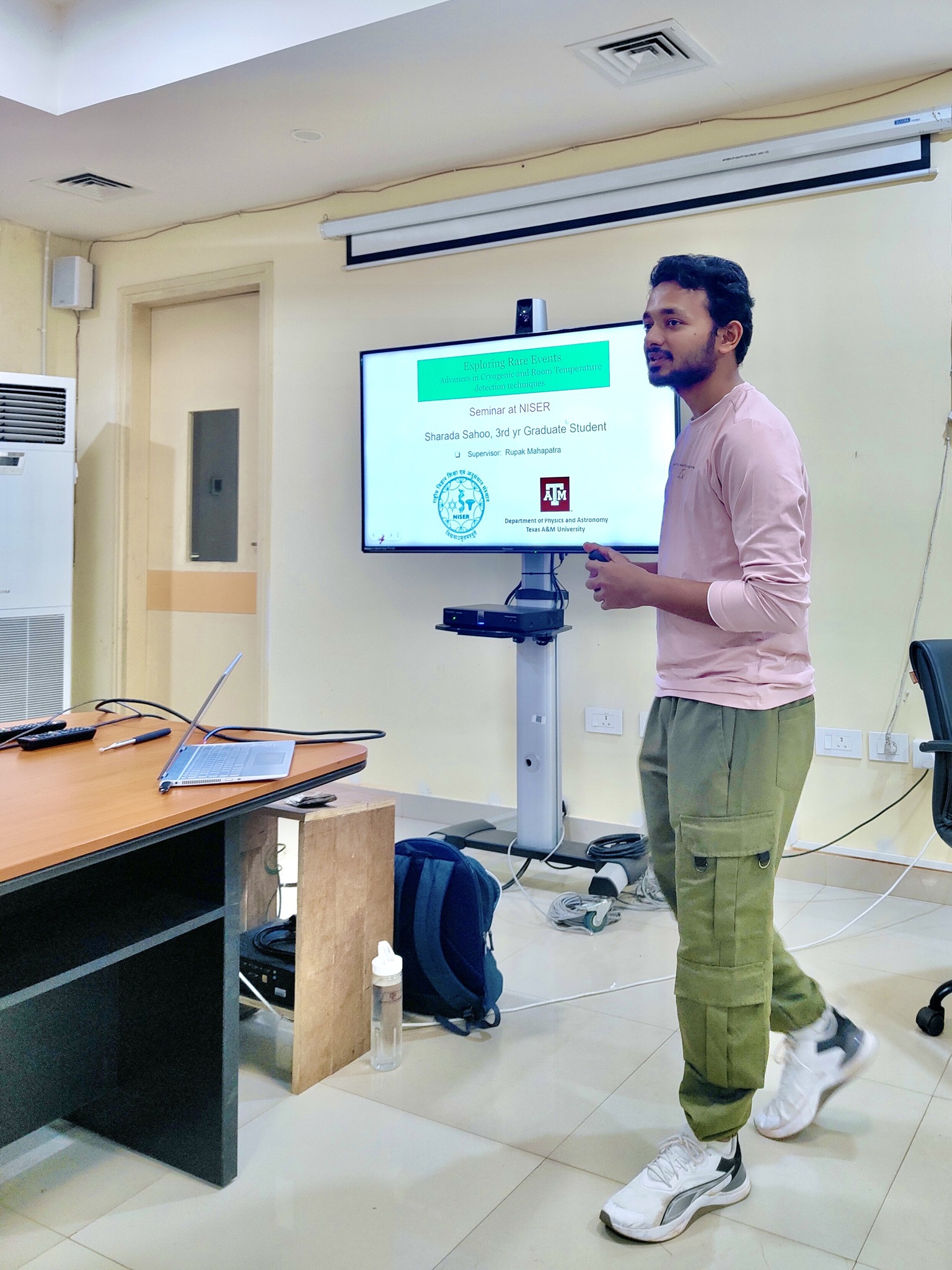
Mr. Sharada Prasad Sahoo (M.Sc.: 2020–2021)
Pursued M.Sc. thesis research at NISER
After masters: Graduate Student, University of Texas A&M, USA
Characterization studies of detectors for the search of rare events
Research Summary:
This M.Sc. thesis focuses on the characterization and performance evaluation of cryogenic phonon-mediated detectors developed for the detection of rare low-energy events, particularly coherent elastic neutrino–nucleus scattering (CEνNS) and low-mass dark matter interactions, in the context of the MINER (Mitchell Institute Neutrino Experiment at Reactor) program.
- Studied three detector technologies used in rare-event searches: Silicon High-Voltage (SiHV), Hybrid Silicon, and Sapphire (Al2O3) cryogenic detectors.
- Performed energy calibration using radioactive sources (55Fe, 241Am, 252Cf) and validated detector response using pulse integral and optimal filter techniques.
- Demonstrated Neganov–Trofimov–Luke (NTL) phonon gain, enabling enhanced sensitivity to sub-keV nuclear recoils through high-voltage biasing.
- Quantified baseline energy resolution as a function of bias voltage, showing that noise contributions remain controlled while signal amplification improves detector performance.
- Used partition plots to localize interaction positions within detectors and verify uniform phonon collection.
- Demonstrated electron recoil (ER) versus nuclear recoil (NR) discrimination using the hybrid detector geometry, a key requirement for background rejection in CEνNS and dark-matter searches.
- Studied sapphire–silicon detector correlations, exploiting combined phonon and photon-mediated energy transport to improve energy resolution and event identification.
The results establish the feasibility of using phonon-based cryogenic detectors with high-voltage amplification and geometric discrimination to achieve the ultra-low energy thresholds required for next-generation neutrino and dark-matter experiments. The work provides essential validation for detector technologies deployed in the MINER experiment.

Mr. Aditya Prasad Dash (BS–MS: 2016–2021)
BS–MS thesis research at IISER Berhampur (STAR experiment, RHIC)
After masters: Graduate Student, UCLA, USA
Research Summary:
This BS–MS thesis presents a detailed experimental study of directed flow (v1) and the first moment of transverse momentum projected onto the spectator plane (⟨px⟩) in Au+Au collisions at √sNN = 27 GeV, using data collected by the STAR experiment at the Relativistic Heavy Ion Collider (RHIC) during the 2011 and 2018 runs.
- Measured rapidity-odd and rapidity-even components of directed flow for inclusive charged particles and identified hadrons (π±, K±, p, p̄) as functions of rapidity/pseudorapidity, transverse momentum, and collision centrality.
- Used the event-plane method with spectator planes determined independently from the BBC (2011, 2018) and the Event Plane Detector (EPD) (2018), achieving improved first-order event-plane resolution.
- Demonstrated the expected antisymmetric rapidity dependence of v1odd and the non-zero v1even component, indicating the presence of initial-state fluctuations in the collision geometry.
- Observed a characteristic sign change of v1 and ⟨px⟩ as a function of transverse momentum, consistent with momentum conservation and collective dynamics.
- Studied the centrality dependence of directed flow slopes, finding larger magnitudes in peripheral collisions, reflecting the increasing role of geometric asymmetry.
- Compared experimental results with calculations from the A Multi-Phase Transport (AMPT) model, finding qualitative agreement in the trends of odd and even flow components.
The thesis provides a comprehensive characterization of directed flow at intermediate RHIC energies and offers important constraints on the early-time dynamics, initial-state fluctuations, and equation of state of QCD matter. The results complement previous STAR and ALICE measurements and contribute to the broader understanding of collective phenomena in relativistic heavy-ion collisions.

Mr. Aman Upadhyay (MSc: 2021–2022)
MSc thesis research at NISER
After masters: Graduate Student, Rutgers University, USA
Anomaly Detection and pulse separation for direct dark matter searches
Research Summary:
This MSc thesis focuses on data analysis and detector-response modeling for direct dark matter searches. It applies unsupervised machine-learning techniques to identify and classify rare-event signals in cryogenic detector data.
- Implemented t-SNE and DBSCAN algorithms for anomaly detection, successfully separating signal-like pulses from noise, pile-up, and saturated events in sapphire detector data.
- Developed a pulse simulation framework for semiconductor detectors, modeling phonon and charge production from particle interactions.
- Demonstrated improved signal discrimination and background rejection, relevant for low-threshold searches in experiments such as SuperCDMS and reactor-based CEνNS detectors.
The work provides practical tools for rare-event searches and supports the use of machine learning in next-generation direct dark matter and neutrino experiments.

Mr. S. Danush (MSc: 2021–2022)
MSc thesis research at NISER
After masters: Graduate Student, University of Chicago, Illinois, USA
Simulations and prototyping of an MPGD and a wire-based detector
Research Summary:
This MSc thesis focuses on the design, fabrication, and characterization of gaseous detectors, with emphasis on a Thick-GEM (THGEM)–based Micro-Pattern Gaseous Detector and a wire-based proportional counter.
- Designed and fabricated a 10 × 10 cm² Thick-GEM detector, including gas-tight enclosure, readout strips, and high-voltage protection circuitry.
- Performed electric-field and gain simulations using Garfield++ and neBEM to study charge transport, avalanche multiplication, and detector performance.
- Built and characterized a proportional counter, studying gain evolution, energy resolution, and operational stability using an ⁵⁵Fe X-ray source.
The work provides hands-on experience in MPGD development, detector simulations, and experimental characterization, relevant for applications in high-energy physics and radiation detection.

Mr. Abhishek Anil Deshmukh (MSc: 2022–2023)
MSc thesis research at NISER
After Masters: Graduate Student, University of Wuppertal, Germany
Neural Networks for f0(980) Detection in pp Collisions at √s = 5.02 TeV
Research Summary:
This MSc thesis applies machine learning techniques to improve the measurement of the f0(980) resonance in pp collisions at √s = 5.02 TeV using ALICE Run-2 data.
- Developed a multilayer perceptron (MLP) classifier to separate f0(980) signal from combinatorial background in the π+π− decay channel.
- Demonstrated a ~10³ improvement in signal-to-background ratio and a ~3× increase in statistical significance compared to standard invariant-mass analysis.
- Performed full analysis using ALICE reconstruction, PID, Monte-Carlo simulations, and TensorFlow-based training.
The work highlights the potential of machine learning–assisted resonance reconstruction for high-background environments, with relevance for future heavy-ion and small-system analyses.

Mr. B. Rajesh Achari (Integrated MSc: 2022–2023)
MSc thesis research at NISER
After Masters: Graduate Student, Università di Bologna, Italy
Simulation and Characterization of Thick Gas Electron Multiplier
Research Summary:
This MSc thesis focuses on the design, simulation, fabrication, and experimental characterization of a Thick Gas Electron Multiplier (THGEM) detector for X-ray detection.
- Performed detailed electric-field and gain simulations using ANSYS and Garfield++ for various voltage configurations.
- Designed and assembled a 10 × 10 cm² THGEM detector chamber, including leak-rate testing and optimisation of gas operation.
- Experimentally measured effective gain, charging-up effects, and energy resolution using a 55Fe X-ray source with Ar–CO₂ (70:30) gas mixture.
The work demonstrates the stability and suitability of THGEM detectors for gaseous radiation detection and provides a validated comparison between simulation and experimental performance.

Ms. Anna Binoy (Integrated MSc: 2023–2024)
MSc thesis research at NISER
After Masters: Graduate Student, Kansas State University, USA
Study of differential transverse momentum fluctuations in pp collisions at LHC energies
The MSc thesis investigates differential transverse-momentum fluctuations in high-multiplicity pp collisions using the observable v₀(pT), based on ALICE Run-2 data and PYTHIA 8 simulations.
The analysis reveals species dependence and mass ordering of v₀(pT) at low pT in high-multiplicity events, suggesting possible collective behavior in small systems, and includes robustness studies with respect to detector efficiency and Run-3 data.

Mr. Arpan Maity (Integrated MSc: 2023–2024)
MSc thesis research at NISER
After Masters: Graduate Student, Weizmann Institute of Science, Israel
Studies on a proposed muon identification system for ALICE 3
The MSc thesis focuses on simulation-based studies of a proposed muon identification system for the ALICE 3 experiment, evaluating detector layouts, performance metrics, and physics reach for efficient muon reconstruction in high-multiplicity environments.
Mr. Abhishek (Integrated MSc: 2023–2024)
MSc thesis research at NISER
After Masters: Graduate Student, University of Tennessee, Knoxville, USA
Thesis work involves GEANT4-based simulations of cosmic-ray muon scattering tomography, development and validation of POCA and Binned Clustering Algorithms for high-Z material imaging, and design, construction, and characterization of glass RPC detectors for a portable muon telescope.
Mr. Anantha Padmanabhan M Nair (Integrated MSc: 2024–2025)
MSc thesis research at NISER
After Masters: Graduate Student, Kent State University, USA
Study of exclusive four-pion photoproduction in ultra-peripheral Pb–Pb collisions at √sNN = 5.36 TeV
Analysis of Run-3 ALICE Pb–Pb UPC data using the O2 framework, including signal extraction, acceptance–efficiency corrections, cross-section measurements, and angular distributions to study the polarization of excited ρ′ vector mesons.
Integrated MSc-PhD Students who did Master's thesis project
Rik Bhattacharyya [2017-2019] Following his MSc, he is going to join as a graduate student in Texas A&M University,College Station, TX to work in SuperCDMS experiment. Study of 32Si background for CDMS II and neutron detector for dark matter search experiments
The first part of this thesis is focussed on 32Si background analysis in Cryogenic Dark Matter Search (CDMS) experiment. 32Si is an important background in low-mass dark matter search experiments that use Si detectors. To estimate this background, both simulation of low-energy beta decay spectrum and charge energy spectrum from CDMS II data is required. In direct dark matter search experiments, neutron is an important background as it can mimic WIMPs signals. To understand the neutron background, neutron detector is studied at NISER as second part of the thesis.
Some Selected Semester (6th) Projects
Diptanil Roy [2017]Current pursuing MSc at NISER. Sixth semester project was on:
Study of spin polarisation in simulated high energy pp and heavy ion collisions. Presentation in the School
Maneesha ushama Pradeep [2013] Following her MSc, she joined as a graduate student in University of Illinois at Chicago. Sixth semester project was on:
Shear viscosity of a hadron gas. Presentation in the School
Srijit Paul [2013] Following his MSc, he joined as a graduate student with Prof. Constantia Alexandrou at The Cyprus Institute and Prof. Dirk Pleiter at the University of Regensburg ( also at the Forchungszentrum Juelich). Sixth semester project was on:
Solving 1+1 Dimension Hydrodynamics Equations and Studying its applications