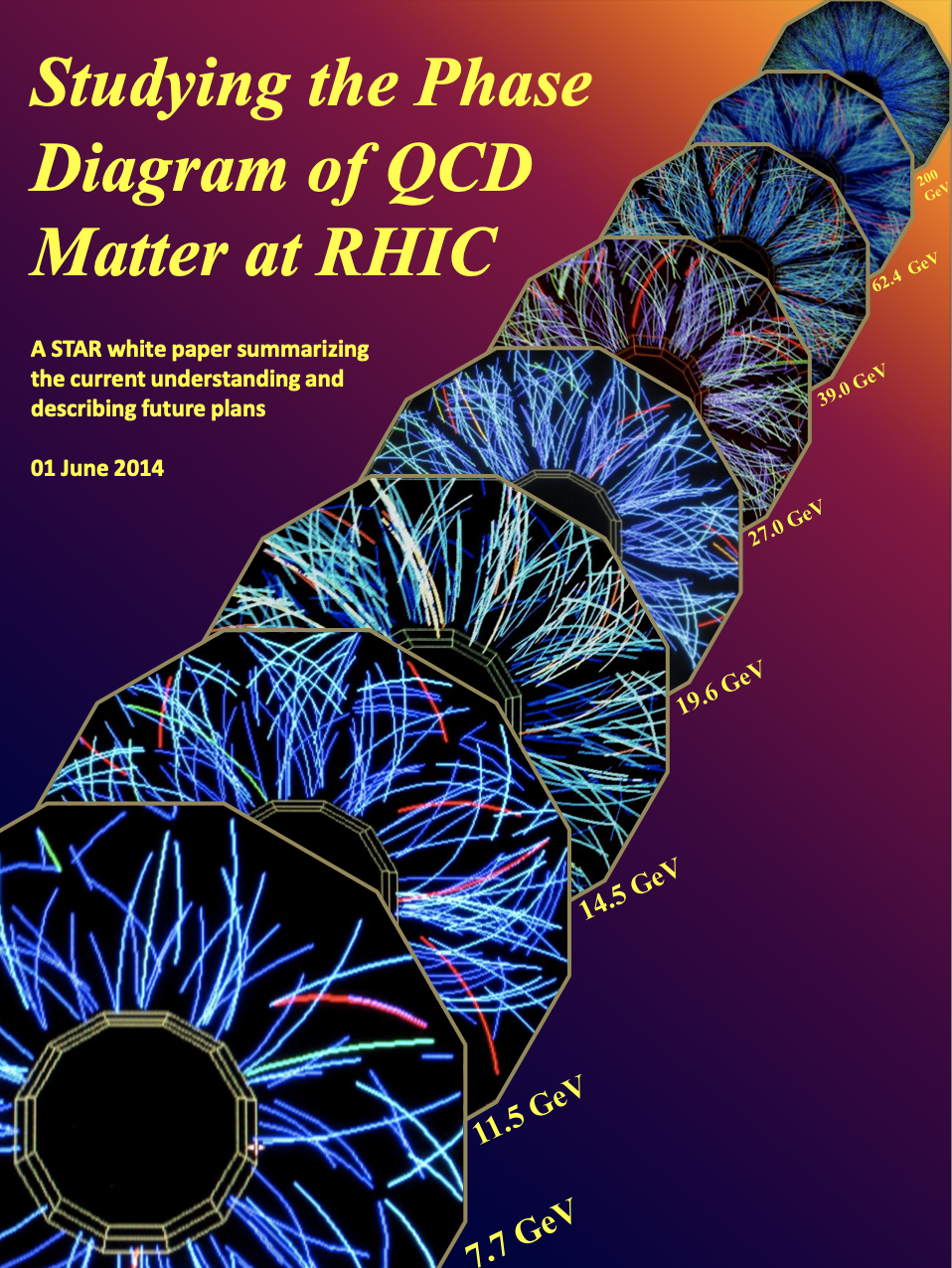
The RHIC Beam Energy Scan (BES) program is a major scientific initiative of the STAR experiment at the Relativistic Heavy Ion Collider (RHIC), Brookhaven National Laboratory, designed to map the phase structure of strongly interacting matter. By varying the collision energy over a wide range, the program probes different regions of the QCD phase diagram in temperature and baryon chemical potential, enabling experimental searches for the crossover transition, the first-order phase transition, and the QCD critical point.
The BES program opened a new experimental frontier in relativistic heavy-ion physics. It has provided the first systematic access at RHIC to a broad range of baryon chemical potentials and has become one of the central international programs for understanding the QCD phase diagram.
My Role in the BES Program
I was one of the co-founders of the BES program at RHIC and played a central role in building the scientific case for it. I was a primary author of the major documents that helped initiate the program and define its direction. These included the early STAR document on the experimental study of the QCD phase diagram and search for the critical point, and the later STAR white paper that summarized BES-I results and laid out the roadmap for BES-II. I analyzed the BES-I and BES-II data and brought out the physics related to the QCD phase structure of the strong interaction phase diaggram. I presented the first results from the program at the top most conference in our field - Quark Matter.
Program building
My work helped gather collaboration-wide and community-wide support for the BES program and shape it into a multi-year RHIC initiative. This included identifying the most compelling scientific questions, defining the key observables, and helping establish the program as a flagship direction for STAR and RHIC.
Scientific strategy
I contributed to the physics vision that underlies the program: using energy-dependent measurements of fluctuations, flow, particle production, correlations, and electromagnetic probes to search for the critical point, the softest point of the equation of state, threshold behavior for QGP signatures, and the turn-off of partonic phenomena at lower beam energies.
Why the Beam Energy Scan Was Needed
Quantum Chromodynamics predicts a rich phase structure for strongly interacting matter. At small baryon chemical potential, lattice QCD calculations indicate a smooth crossover transition between hadronic matter and quark-gluon plasma. At larger baryon chemical potential, QCD-based models suggest a first-order phase transition and the possible existence of a critical point separating the two regimes. The only way to access these different regions experimentally is to vary the collision energy over a wide range, thereby changing the initial temperature and baryon chemical potential of the matter created in heavy-ion collisions.
RHIC advantage
RHIC provided the unique capability to perform a collider-based beam energy scan with the same detector over a broad energy range. This allowed STAR to make measurements with uniform acceptance and strong particle-identification capability while sampling different parts of the QCD phase diagram from top RHIC energies down to much lower energies.
Physics reach
The BES program has covered a broad range in collision energy and baryon chemical potential, from the crossover regime toward the higher-density region where first-order phase transition and critical-point signatures may appear. Later BES-II and fixed-target measurements further extended this reach and precision.
Key Physics Questions
Critical point and phase transition
- Does the QCD critical point exist?
- Where is the boundary between crossover and first-order phase transition?
- Can fluctuation observables reveal non-monotonic behavior linked to critical phenomena?
- Is there evidence of a softest point in the equation of state?
Turn-off of QGP signatures
- At what collision energy do partonic signatures begin to disappear?
- How do elliptic flow, directed flow, RCP, and other observables evolve with beam energy?
- How does the balance between partonic and hadronic interactions change across the scan?
- What does this reveal about the onset of deconfinement?
Key Observables and Strategy
The BES strategy relied on measuring a carefully chosen set of observables that are sensitive to different aspects of the QCD phase structure. The early BES documents emphasized the turn-off of established high-energy RHIC phenomena, signatures of a softest point, and higher moments of conserved-quantity distributions as especially powerful probes.
Observables for threshold and medium studies
- Constituent-quark-number scaling of elliptic flow (v2)
- Hadron suppression in central collisions through RCP
- Pair correlations in pseudorapidity and azimuth
- Local parity violation related observables
- Dilepton production and electromagnetic probes
Observables for critical point and first-order transition
- Directed flow and elliptic flow of identified particles
- Azimuthally sensitive femtoscopy
- Higher moments and cumulants of net-proton, net-charge, and net-strangeness distributions
- Proton-pair correlations
- Centrality-dependent and energy-dependent non-monotonic trends
Program Evolution: BES-I, BES-II and Fixed-Target
BES-I established the first trends and identified the most interesting collision-energy region, especially below about 20 GeV, where signatures connected with the critical point, first-order transition, and the turn-off of partonic behavior could emerge most clearly. BES-II built on those results with higher luminosity, detector upgrades, and targeted precision measurements. The fixed-target program extended the reach to even larger baryon chemical potential, enabling access to a wider portion of the QCD phase diagram.
Accelerator, detector, and observable readiness
One of the important contributions of the early BES documents was to show that STAR and RHIC were ready for a successful low-energy scan. This readiness was not only about accelerator performance and detector acceptance, but also about demonstrating that the right observables were already identifiable and experimentally accessible for a meaningful exploration of the QCD phase diagram.
The short Run-10 BES document summarized the experimental arguments, the role of the large-acceptance STAR detector, and the feasibility of operating RHIC below nominal injection energy. In parallel, the 9.2 GeV STAR feasibility paper demonstrated that identified particle production, azimuthal anisotropy, interferometry, and related measurements at sub-injection energy were consistent with expectations and showed that the STAR detector was suitable for the proposed critical-point search and phase-diagram exploration.
The higher-moments paper then established one of the most important observable directions for the BES program by showing that higher moments of net-proton multiplicity distributions are directly sensitive to the correlation length and can provide strong access to critical fluctuations. Together, these works demonstrated readiness at three levels: accelerator readiness, detector readiness, and observable readiness.
Precision phase
The BES-II white paper laid out the roadmap for precision measurements using improved luminosity, enhanced collider performance, and detector upgrades such as the iTPC and EPD, enabling substantially better sensitivity to key observables.
Landmark Outcomes
Over the years, the BES program has delivered some of the most influential results in the study of the QCD phase diagram. It has narrowed the most interesting energy region for the search for the critical point, provided important evidence on the relative importance of partonic and hadronic interactions as beam energy changes, and led to high-impact measurements of net-proton fluctuations and related observables. These results have also helped motivate parallel theoretical efforts and lower-energy accelerator programs elsewhere in the world.
The BES program is now recognized as one of the defining long-term scientific initiatives of RHIC and STAR, and it has fundamentally reshaped the global effort to map the QCD phase diagram.
Linked BES Documents
Key documents associated with launching and shaping the BES program
-
Experimental Study of the QCD Phase Diagram and Search for the Critical Point: Selected Arguments for the Run-10 Beam Energy Scan at RHIC
A concise STAR document summarizing the experimental arguments, observables, and RHIC/STAR readiness for the first BES program. -
Studying the Phase Diagram of QCD Matter at RHIC
The STAR white paper reviewing BES-I results and defining the scientific case and measurement plan for BES Phase-II.
Vision
The RHIC Beam Energy Scan program represents one of the most ambitious and intellectually important efforts in experimental nuclear physics: the attempt to map the phase diagram of QCD matter in the laboratory. It brings together accelerator physics, detector capability, precision measurement, and theoretical interpretation in a coordinated long-term program. I am proud to have helped conceive, shape, and advance this program from its earliest documents to its most influential physics results.